BGCP_04
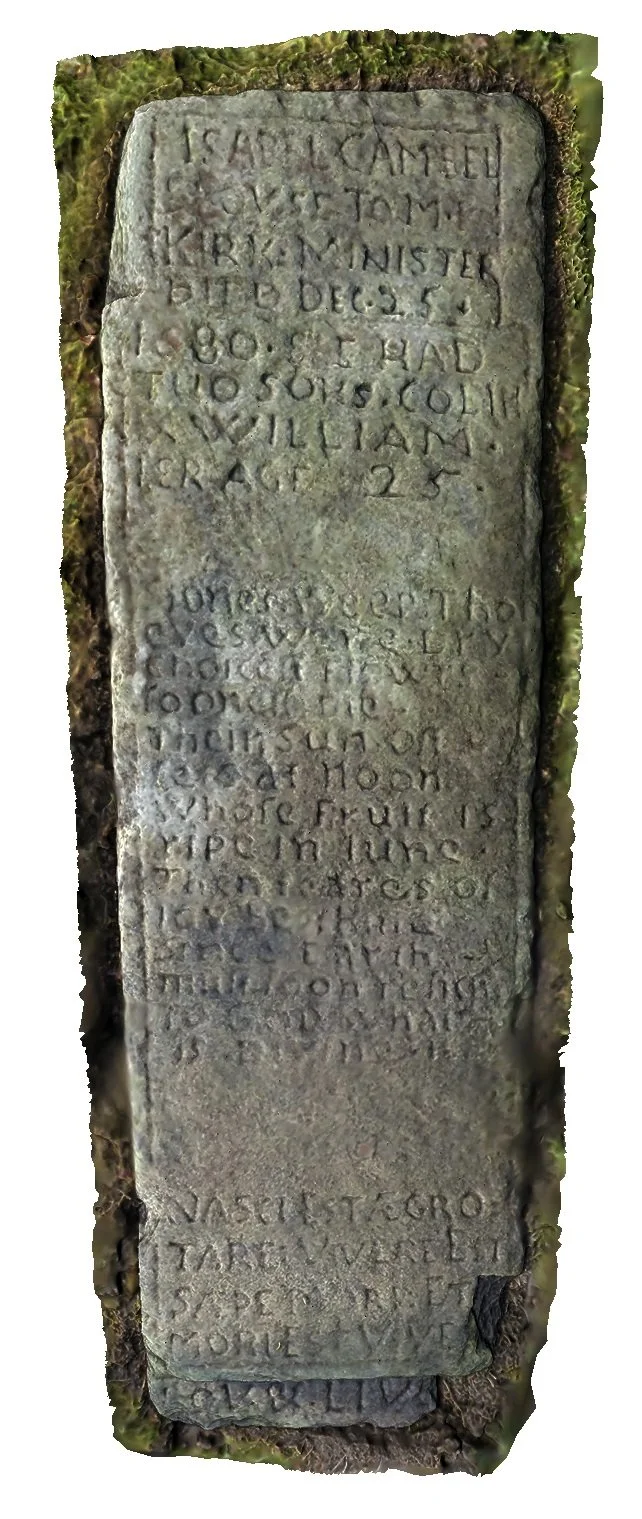
Isabel Cambel’s grave (first wife of Rev. Robert Kirk, minister at Balquhidder)
Site co-ordinates: 14.50/15.50
3D model here
The slab, aligned W–E, lies 10 m SW of the SW corner of the Old Kirk. It is approximately rectangular, measuring 2.21 m long on its north side and 2.13 m on its S. It is up to 0.68 m wide, narrowing slightly to the E. The slab has been cut down for some 0.13 m from its E end, creating a narrow ledge 0.02–0.05 m lower than the rest of the slab’s surface.
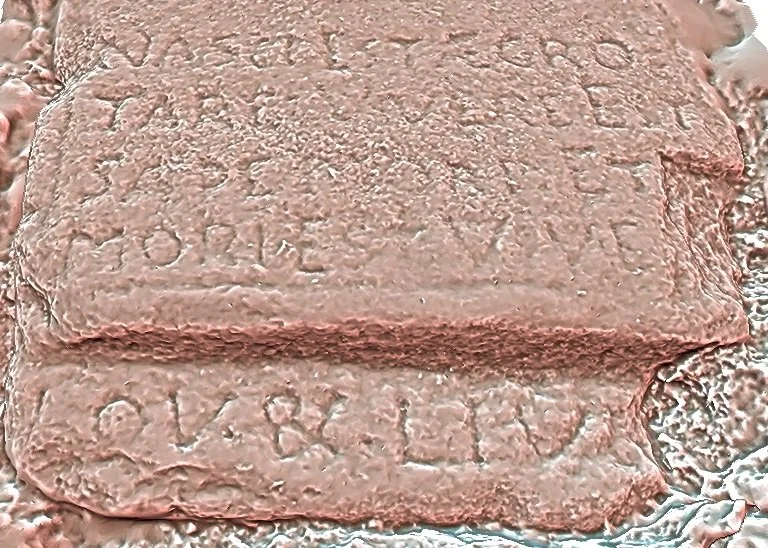
The NE corner of the slab has been damaged, with a large flake lost. It appears that this happened since the burial as 19th-century references to the inscription read the last word of the section of Latin text as VIVERE (eg Rogers 1872, 149), whereas now the last two letters (RE) have been lost.
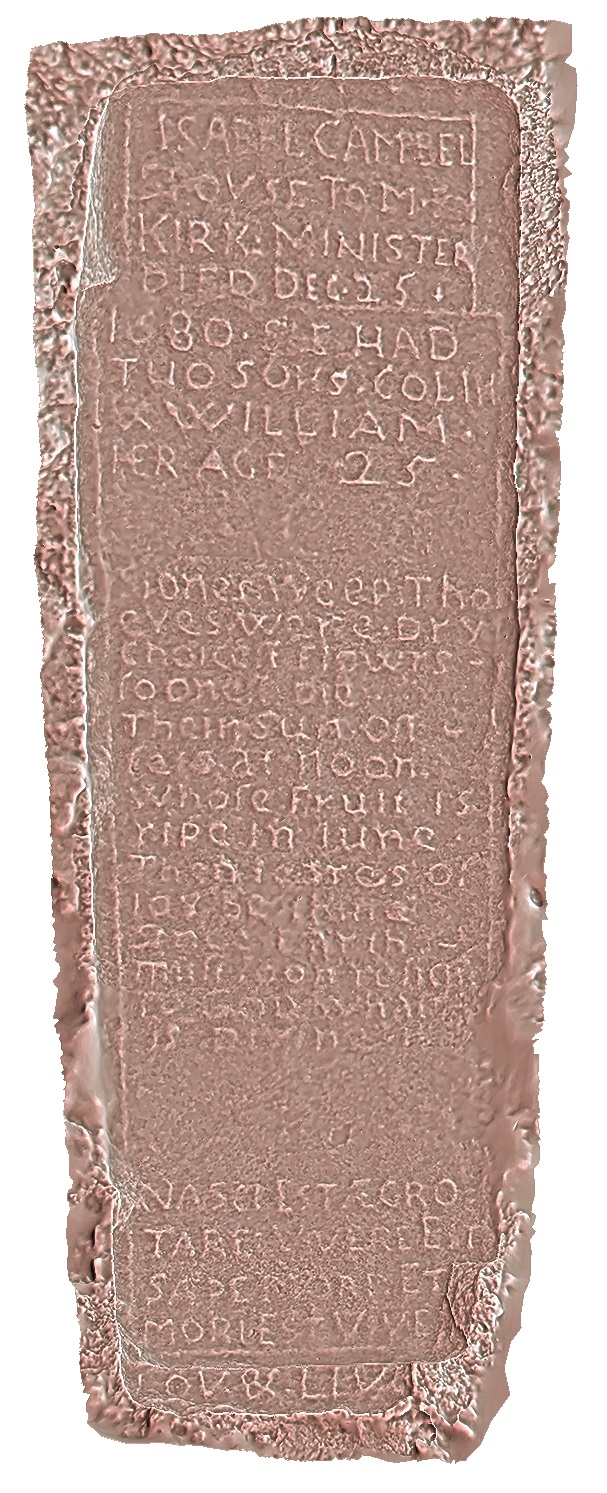
There are two sections of border around the edge of the slab’s main surface. At the head, an incised line, up to 90 mm from the edge, defines a rectangular field, 0.62 m by 0.35 m. Below that, the line steps out closer to the edge creating a border only 0.04 m wide around the rest of the slab surface. There is no border on the lower ledge at the foot.
According to Fergusson (1895, 228), Kirk ‘cut out with his own hand’ the inscribed epitaph. There are three sections of text on the main surface, separated by blank areas 0.15 m and 0.25 m wide at the W and E, respectively.
At the head, in upper-case lettering, are eight lines of text, but there is no break in the text where it crosses the border line.
ISABEL CAMBEL
SPOVSE TO MR
KIRK MINISTER
DIED DEC. 25
1680. SHE HAD
TWO SONS, COLIN
& WILLIAM.
HER AGE 25.
The surname appears to be spelled CAMBEL, although there is a faint suggestion of an MP ligature. This may have been used because the wider border at the head of the slab left less room for text.
The middle field of the inscription comprises 14 lines in rather irregular lower-case lettering, forming a 7-line verse, each line split across two lines of inscription:
Stones Weep Tho' / eyes were Dry
choicest Flowers / soonest die.
Their Sun oft / sets at Noon,
Whose Fruit is / ripe in June.
Then tears of / joy be thine,
Since Earth / must soon resign
To God what / is Divine.
The field at the foot has four lines of upper-case Latin:
NASCI EST AEGRO
TARE. VIVERE EST
SAEPE MORE. ET
MORI EST VIVE[RE].
This may be translated as:
I was born to be sick [or grieve]. To live is to die often. And to die is to live
The lower ledge at the foot of the slab, bears the words:
LOV . & . LIVE
Before recording, this part of the inscription was grown over with turf and therefore not visible. The visible edge at the foot of the slab, defined by the border, appeared to be the end of the slab.
It is possible that the slab was fashioned in this way so that this last line of inscription could be covered over and so hidden from public view, perhaps having some shared private significance to Robert Kirke and his deceased wife.
The phrase is echoed in the inscription Kirk had engraved of the new bell he bought for the church four years later: ‘For Balquhidder Church: Robert Kirk, Priest: Love and Life: Anno 1684’. In addition, Kirk owned a Netherlandish book of hours, made c. 1500, in which he wrote ‘Liber R. Kirke 1676 Love and Live. Balquhidder’ (Ker 1977, 583).
For further information on sources see BGCP Bibliographic References after the last entry.