30/10/2026
Balquhidder Graveyard Claymore Project
Images Credit: BGCP: elainemsblack@gmail.com
A “fan-tastic” discovery has been made at Rob Roy’s Grave in Balquhidder Old Kirk graveyard, in the Loch Lomond and Trossachs National Park.
A 3D imaging project has shone new light on the grave which suggests there may be an early medieval flabellum-style cross on the stone slab believed to mark the Highland Rogue’s final resting place. A flabellum is a ceremonial fan which fell out of use in churches after the Reformation but is still used at papal ceremonies today.
Robert MacGregor died in 1734. However, archaeologists have long suggested that the graveslab was re-used and is much older.
Dr Kelly Kilpatrick, who identified the fan during a recent site visit, said: “On either side of the interlaced top of the flabellum are two smaller bent-arm crosses. The motif of three crosses, with the largest cross representing the cross on which Christ was crucified, is a common theme in early medieval stone sculpture.
“The crosses on the Rob Roy stone have also been carved using a technique called pocking and smoothing, which is characteristic of early Christian sculpture.”
People from all over the world visit Rob Roy’s grave at Balquhidder, first made famous by Sir Walter Scott’s 19th-century novel of the same name. The MacGregor became a Catholic late in life and, if he does lie beneath this slab, it may have been chosen because it looks special.
“The carvings on this amazing stone have a story to tell that spans more than a thousand years,” said Elaine Black, of Balquhidder Graveyard Claymore Project.
“As well as what looks like an early medieval ecclesiastical fan we have later images of a sword, tongs and possibly a herding or hunting scene. A carved figure, thought to depict Rob Roy with his kilt and shield, may itself have been re-purposed from an earlier medieval carving.
“I suspect the Highland Rogue would have loved it if he had been alive today.”
Stirling Archaeologist Murray Cook, who has been advising the project, said: “The area round Stirling has been a cultural and military crossroads for millennia and the hybrid styles and complex history of Balquhidder echo that complexity. This really is a fantastic and nationally important discovery.”
People can explore online 3D images of Balquhidder graveyard’s important collection of medieval carved stones, many of which are partially visible on the ground.
Archaeologist Andrew Powell, who uses a method called photogrammetry, said “3D scanning of graveslabs at Balquhidder reveals important new findings on the early origin of the local church.”
A funding drive has been launched to pay for archaeological reports and the project website can be found at https://www.balquhiddergraveyardclaymoreproject.co.uk/
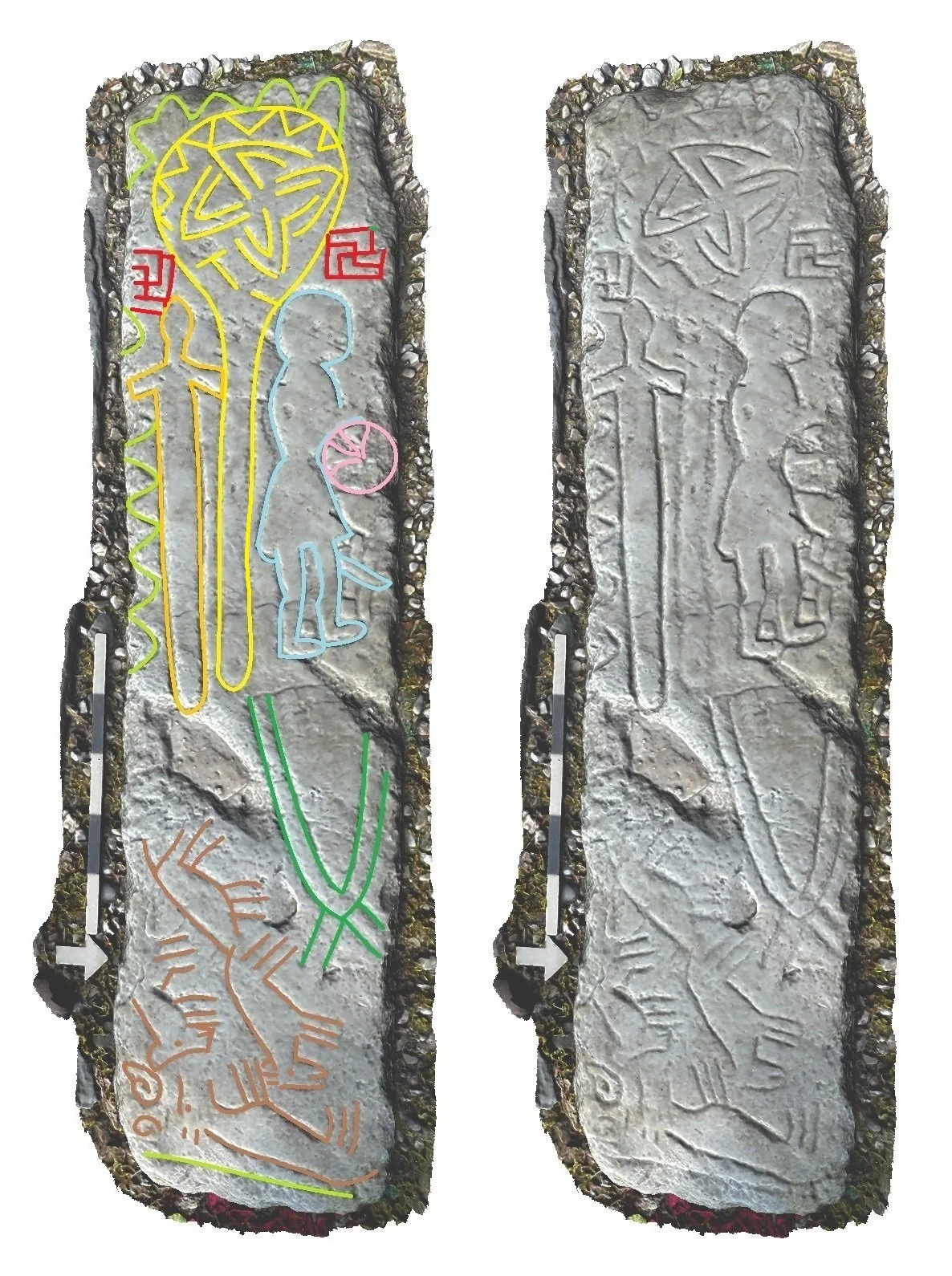

Image 1. Photogrammetric still, Rob Roy graveslab. The suggested medieval flabellum is highlighted in yellow, while the sword, animals, tongs and figure were added later, with a different carving technique. Credit:BGCP.
Image 2. A flabellum is a ceremonial fan which fell out of use in churches after the Reformation but is still used at papal ceremonies today. Credit: wikicommons