In this blog we look at the ‘Rob Roy graveslab’ and what this fascinating reused stone might tell us about Balquhidder’s elusive medieval church.
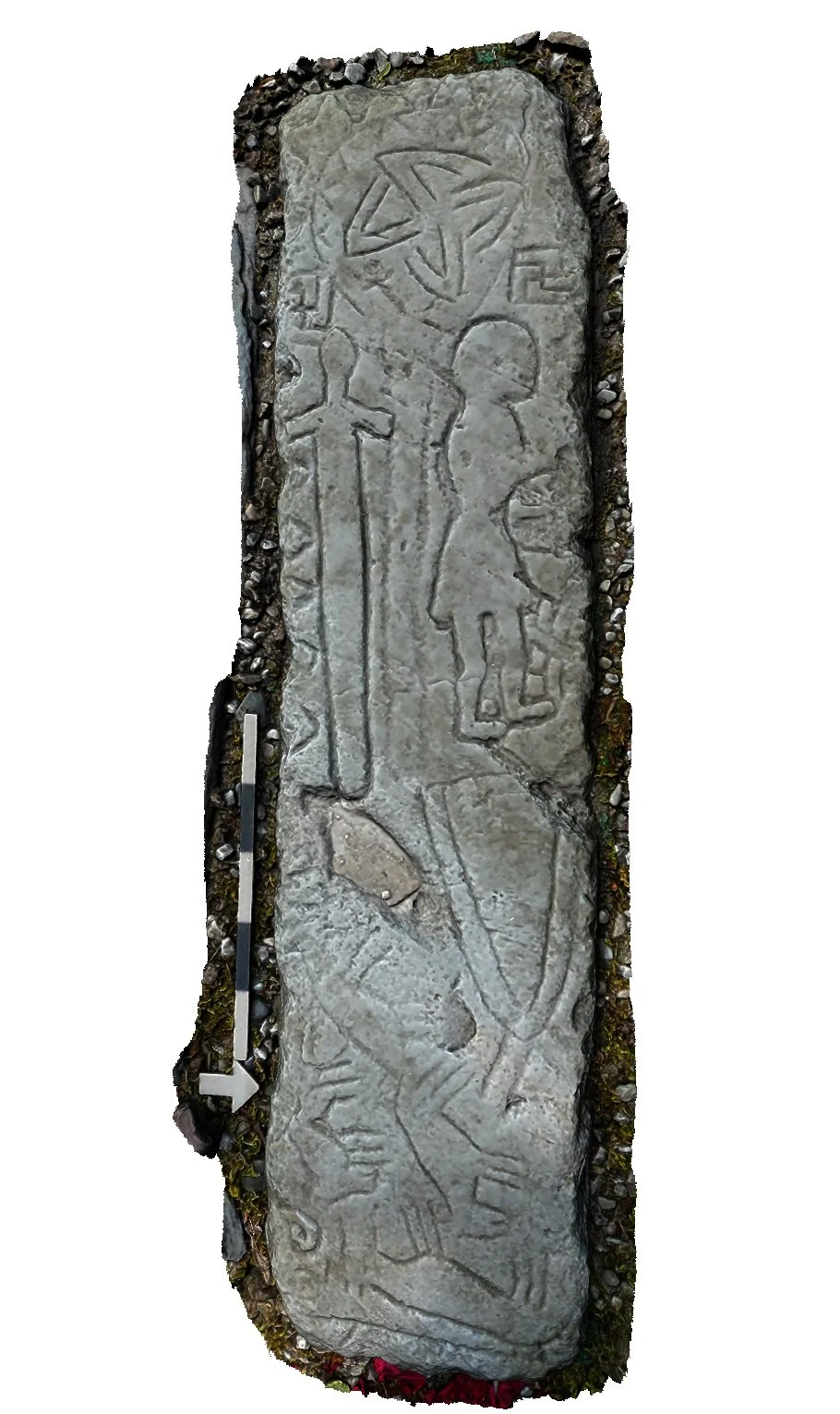
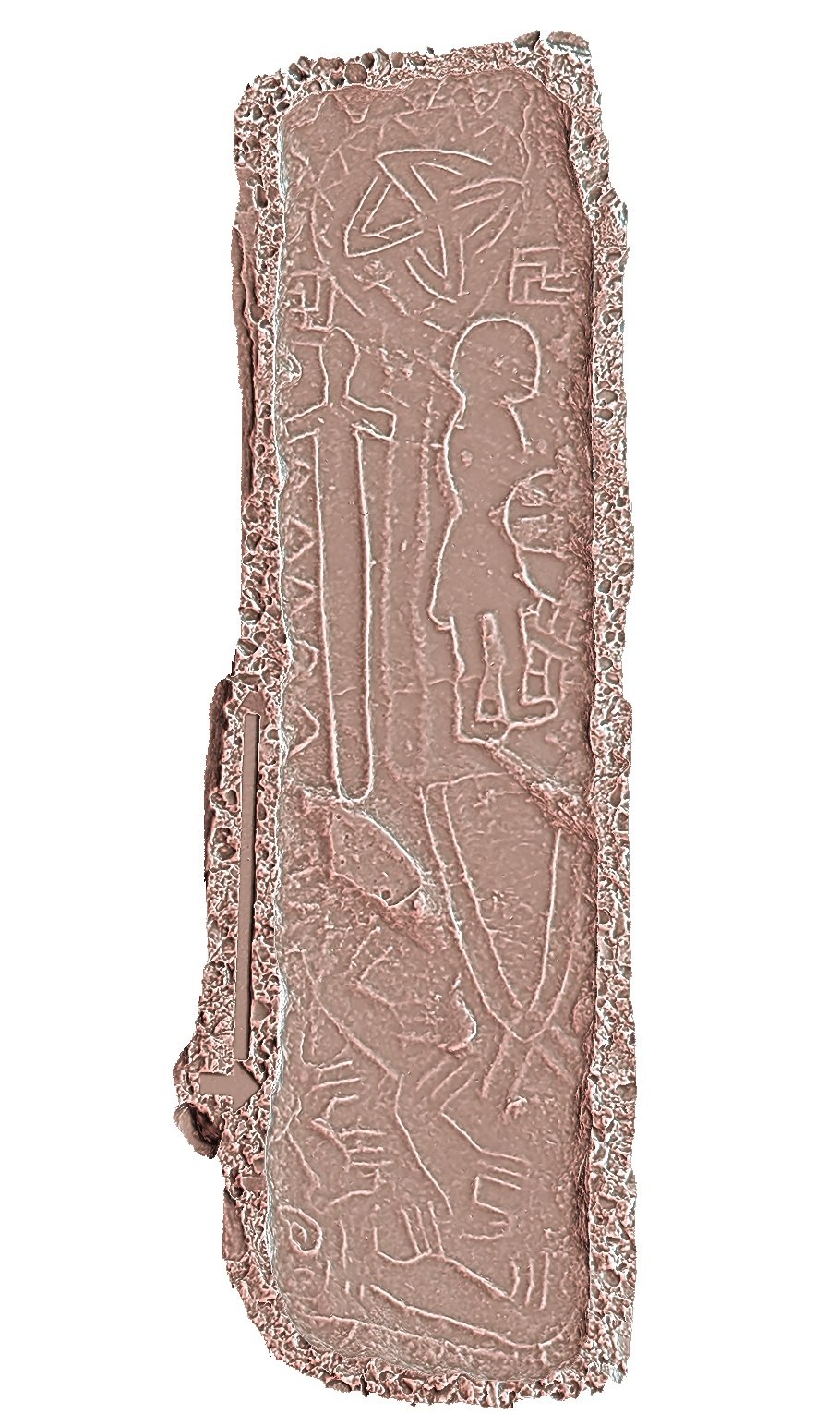
1. Photogrammetric snapshots of the Rob Roy graveslab, Old Kirk, Balquhidder. Credit: BGCP
One of the main attractions that draws visitors to Balquhidder churchyard is a grave marked as belonging to one Robert MacGregor, better known as Rob Roy, the notorious outlaw – or folk hero, depending on one’s point of view, both in the past and still today. Following the publication in 1723 of The Highland Rogue, a fictionalised account of his life, Rob Roy became a legend in his own lifetime. He died in 1734 but his reputation was further burnished by Sir Walter Scott’s novel Rob Roy published in 1817, and he remains a celebrated figure in Scottish and indeed worldwide popular culture.
It is not surprising that the site of Rob Roy’s grave in the churchyard should be prominently marked (albeit contested by some). It lies just outside the eastern entrance to the now-ruined Protestant Old Kirk, which was built in 1631. Some suggest this location might be in the area of the chancel of an earlier medieval, Catholic church (Rob Roy is recorded as having become a Catholic late in his life).
Rob Roy’s grave is marked by the central of three graveslabs surrounded by a low, decorative, cast iron railing. According to plaques on the railing these graves are of (north to south): Helen (Mary) widow of Rob Roy (BGCP_35 – Helen is the name given to her by Sir Walter Scott), Robert MacGregor (Rob Roy) (BGCP_34), and Coll and Robert, sons of Rob Roy (BGCP_33). Today, the slabs often have small items – such as quartz pebbles, coins and flowers – placed on them, indicating a continuing connection some people feel for the character of Rob Roy.
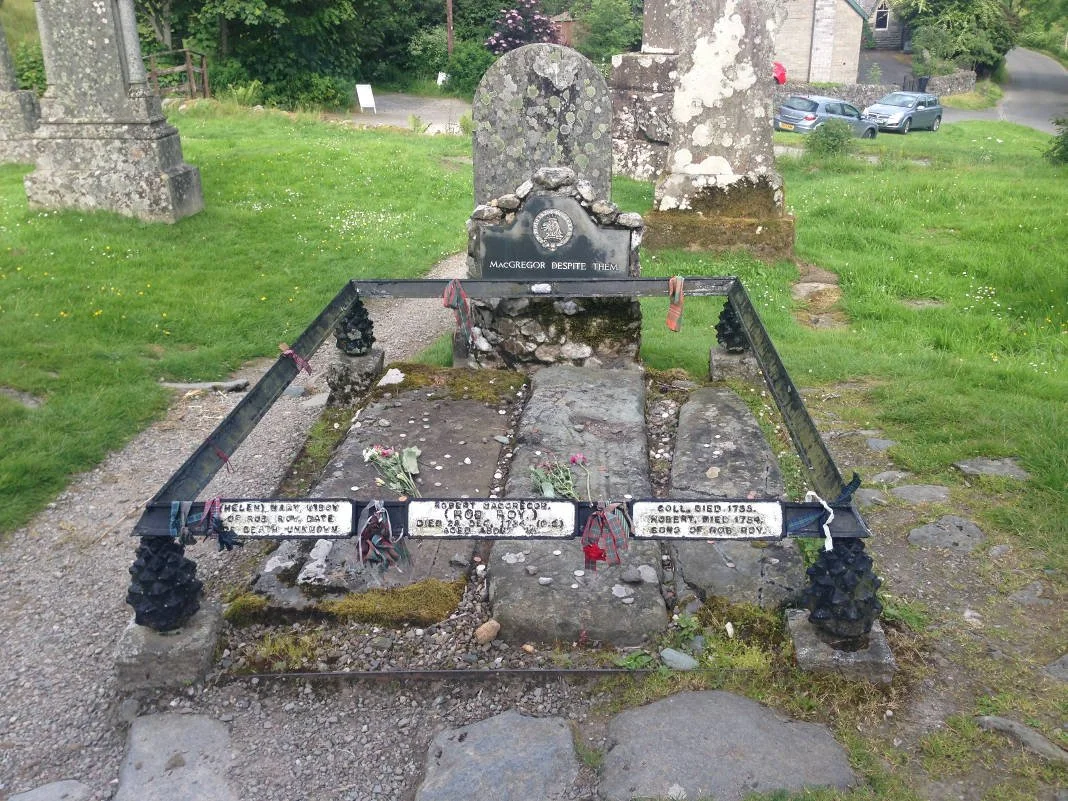
2. Rob Roy’s grave, Balquhidder. Credit: BGCP
However, if we think that the slab placed over Rob Roy’s grave will throw new light on the life and character of this complex man, we have our work cut out for us. The slab has been drawn and photographed many times, starting with Stuart’s illustration in the Sculptured Stones of Scotland Vol 2 (published in 1867) which shows most of the carving in quite accurate detail. The hope for our project, however, was that the use of photogrammetry (see here) might provide a clearer means of looking at the stone, its decoration and its history.
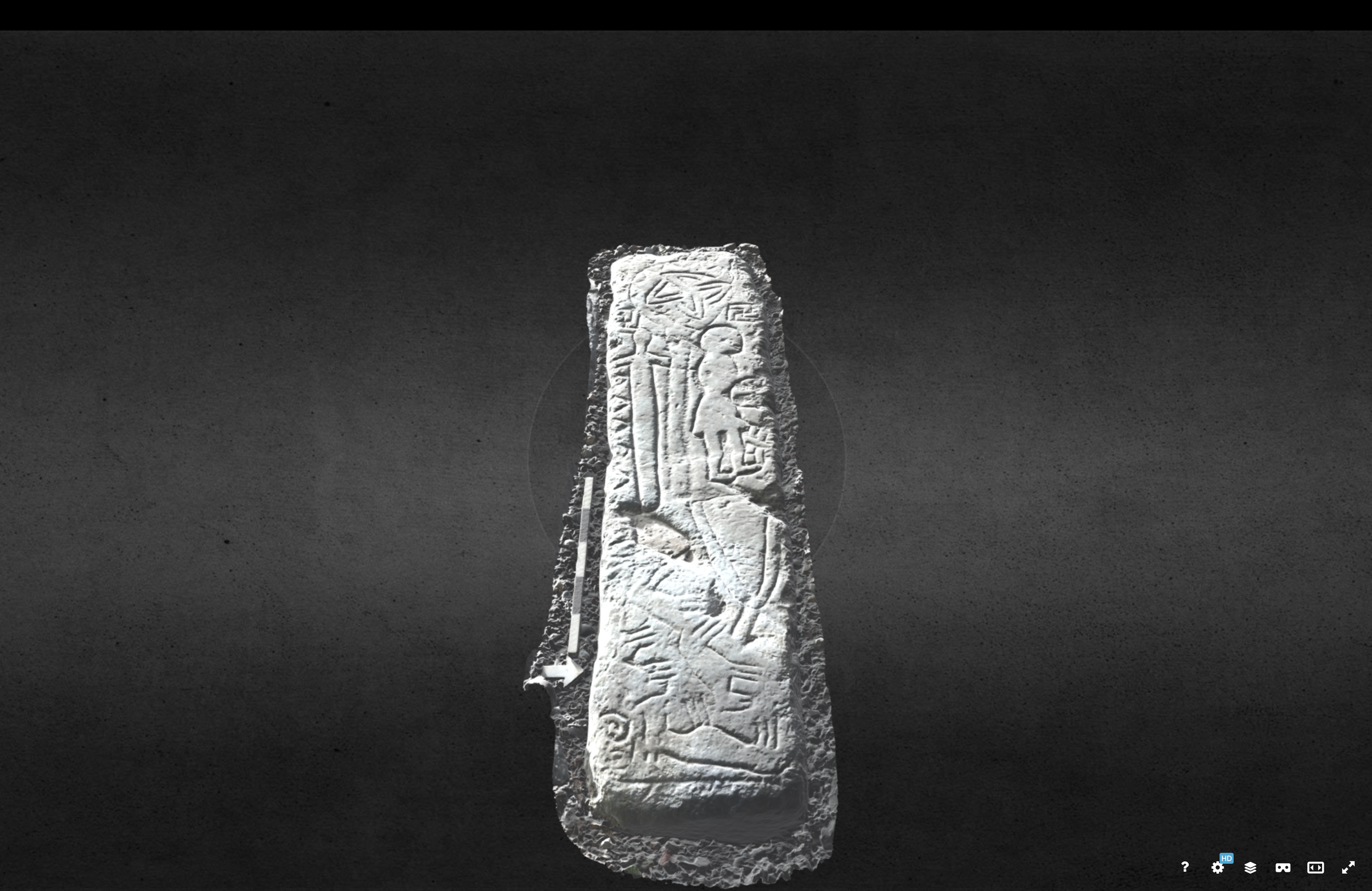
3. Sketchfab image of the Rob Roy graveslab. Credit: BGCP
A number of features of the slab stand out immediately.
Firstly, the stone has a varied and complex lithology with layers of different colour and texture, and shallow striations, running diagonally across it (NE–SW). This is in stark contrast to the regular-shaped sandstone slab to its immediate north (BGCP_35) where the stone appears to have been selected for its relative evenness of texture, facilitating the carving of shallow inscriptions on its flat surface. Unlike many of these later, inscribed slabs, some of the early stones in the graveyard appear to have been selected specifically for their interesting visual appearance. BGCP_24 (Sword, crosses and rings), for example, was possibly selected for the large quartz inclusions around which the carved symbols appear to have been arranged.
Secondly, Rob Roy’s is among the most highly decorated recumbent graveslabs in the graveyard. If one excludes those bearing inscriptions covering most of their surfaces (such as BGCP_04, the grave of Isabel Cambel, first wife of the Rev. Robert Kirk), few other slabs bear such extensive carving; these include Stuart’s plate LXVII no. 1 (yet to be located), BGCP_24 (see above), and BGCP_02 (the Angus Stone). However, of all of these, the decoration on Rob Roy’s graveslab is the most complex and ‘busiest’, comprising many different elements. The decoration extends right up to the edges of the slab, with some elements appearing to have been slightly trimmed, particularly along the north side, perhaps indicating that the stone had originally been slightly wider.
Thirdly, with the exception of the Angus Stone, which bears a full-size effigy of a priest, the Rob Roy slab is the only other stone to incorporate a human figure. The figure, shown in profile, is relatively small and certainly not the central element of the stone. It appears to be wearing a short, waisted tunic and perhaps some form of helmet (possibly a bascinet). It also appears to be holding a circular shield, or targe, which was a symbol of Highland martial prowess from the 16th century until banned following the Battle of Culloden in 1746. The northern edge of the shield is lost, but it appears to be decorated with a cross, or possibly a 5-spoked motif.
Fourthly, the slab bears a wide variety of different decorative elements, some of which are recognisable on other graveslabs of medieval and post-medieval date. These include a sword on the south side of the slab. Like that on the Claymore slab (BGCP_01), this sword has downward sloping quillons (hand guards) and a bulbous pommel, but its short handle suggests it is a single-hand weapon, rather than a two-hand claymore (although this may not have been a significant or intentional distinction in this context). Another familiar element is a group of four unidentified animals upside down at the foot of the slab, which may be compared to hunting scenes depicted on many slabs.
Another prominent feature is the serpentine line which runs along much of the slab’s southern edge and continues around its head. It is possible that it continued down the north side, but was lost if this side had been trimmed, and there are possible traces of it outside a line across the foot of the slab. This feature might be compared with the heavy chevron edging found on various slabs from the west coast (Steer & Bannerman 1977, 53 and Pl. 21C). Alternatively, it could be a crude representation of the single-stem plant scrolls found on a number of slabs and crosses in the 14th and 15th centuries. Also below the standing figure is an object that looks a bit like a pair of garden loppers, with long handles at the top and shorter arms at the bottom, which could be a crude representation of a pair of smith’s tongs, as depicted on a number of grave stones.
However, there are some features towards the head of the stone for which parallels are much harder to find. These include two small bent-arm crosses, each comprising an interlocking square arrangement of 4 L-shaped blocks. Repeated bent-arm cross elements can be the result of various complex knotwork patterns as found on many stones (Romilly Allen 1903), but discrete bent-arm crosses as here are much rarer.
Perhaps the most curious and intriguing element of the stone’s decoration is the central bent-arm cross at the head of the stone, in the location where, on many slabs, one might find a decorative, foliated or plaited cross-head. This motif comprises a large cruciform symbol with four double-lined arms each sharply angled inwards and curving towards the adjacent arm; it might be compared with symbols on an early medieval crosses at Cambusnethan and Govan (see North Lanarkshire Museum Collections). Here the symbol is surrounded by a lightly incised subcircular line, on the inside of which, at the west and north, is a zigzag line. Below the central symbol the subcircular line converges to form a shaft that extends over halfway down the slab. The shaft, however, is marked not by an incised line but by wide pecking, as if an attempt has been made to erase the thinner line. Also of note is the fact that the pecked shaft has a noticeable kink in its line, seeming to avoid the tunic garment of the standing figure.
One might view this complex composite motif as some kind of long-shafted cross, as found in comparable positions on many other graveslabs. However, the arms of the large bent-arm cross at the head are not aligned on the shaft below, as one might expect in a cross. Moreover, the base of the shaft ends at a rounded terminal, rather than being set in a stand (often stepped or semicircular) as is more usually depicted for shafted crosses.
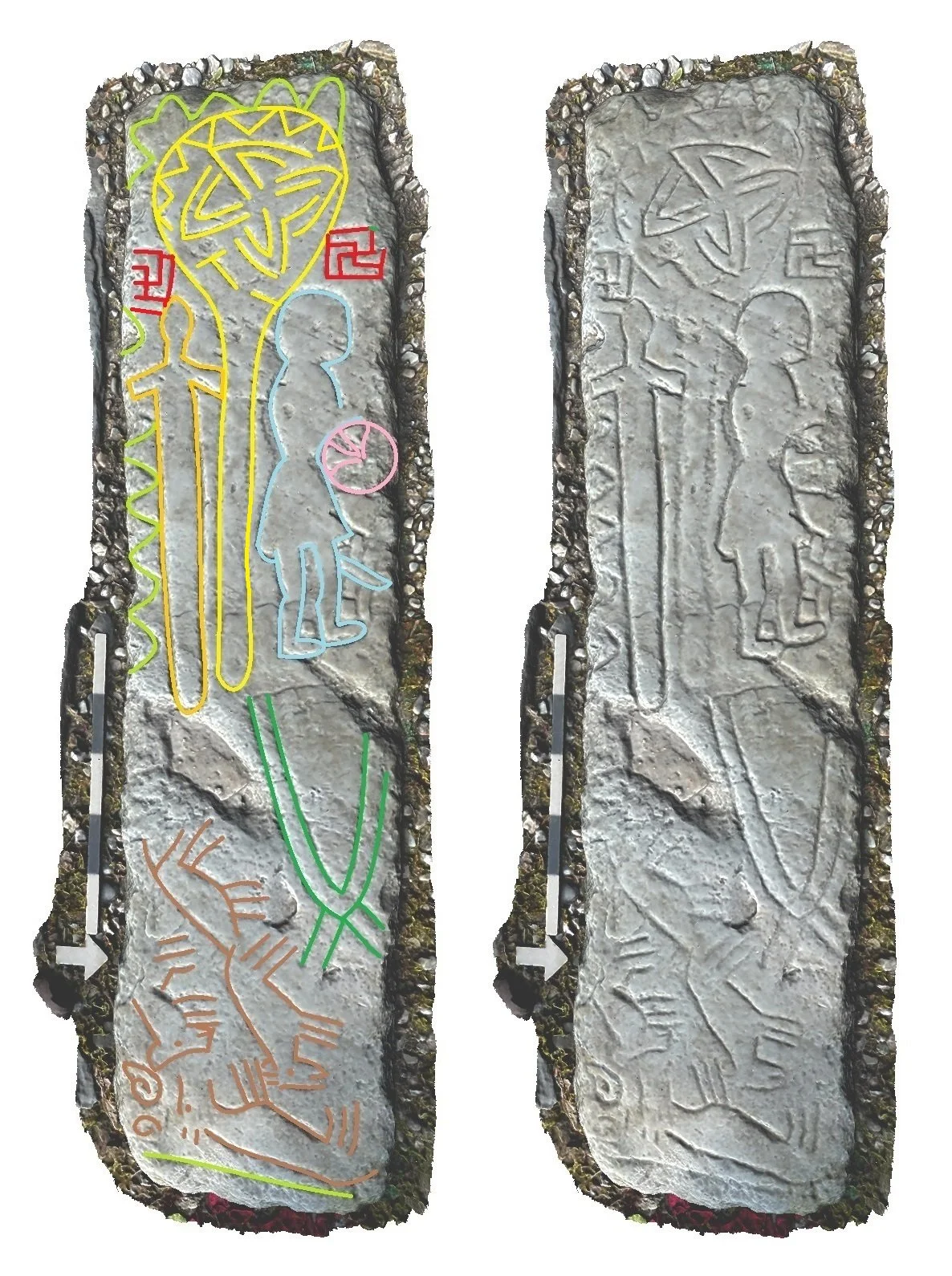
4. Carved motifs on Rob Roy graveslab. Credit: BGCP
But if it is not a cross, then what is it? An intriguing suggestion by Dr Kelly Kilpatrick (pers comm) is that this shafted object could be a flabellum, a ceremonial fan in common use in the Catholic liturgy until the Protestant Reformation, and depicted in British and Irish sculpture from the early medieval to the medieval period. Kelly suggests that other carved elements, such as the sword, tongs and animals, were added later and placed in such a way around the flabellum to make the monument look like a claymore grave slab.

So if we put Rob Roy to one side for a minute (sorry Rob!) this graveslab appears to have a fascinating history in its own right. It is like a palimpsest in stone, possibly early medieval in origin but overwritten perhaps on more than one occasion. It has its own ‘stratigraphy’ which needs to be pealed back to identify the evolving sequence of its symbolism and meaning. For a site where the physical remains of the medieval church have yet to be identified, this stone (BGCP_34) has the potential to add to our understanding the early centuries of the history of the church in Balquhidder – along with the Angus Stone (BGCP_02), the possible ogham-inscribed windowsill (BGCP_64), and others yet to be discussed (eg BGCP_14 and BGCP_26).
It has long been surmised that this slab had an extended history before it was ever placed over Rob Roy’s grave. Writing in 1867, John Stuart remarked (of it and the Angus Stone) ‘It is difficult to say whether their rudeness is to be ascribed to their antiquity or the mere unskilfulness of the artists; but it seems to me that they are the work of a comparatively early period’; and that the Rob Roy slab’s connection with ‘the Highland reiver’ must have been secondary’ (1867, 33). And Betty Willsher, in her survey of the churchyard, wrote ‘This is a very interesting stone: it was a sculptured Pictish stone reused, and a broad two-handed sword added to the carvings’ (Willsher 1986 ).
If not for Rob Roy, then for whom might this slab have been originally created? The depiction of the flabellum might indicate that it once marked the grave of some form of cleric in the medieval church. At least two other graveslabs from the graveyard bear carvings of objects of liturgical significance – the chalice and the priests vestments depicted on the Angus Stone, and the cross with the tenon spike in its base on BGCP_15.
And when, and for whom, was this medieval slab later reworked into a claymore slab? And finally, what was it about this stone that led to its being used to mark the grave of The Highland Rogue – if indeed that is where he was buried!
Allen R A & Anderson J 1 9 03 The Early Christian Monuments of Scotland. Society of Antiquaries of Scotland.
Steer, K A and Bannerman J W M (eds) 1977 Late Medieval Monumental Sculpture in the West Highlands. Edinburgh, RCAHMS
Stuart, J 1867 Sculptured Stones of Scotland Vol 2. Aberdeen, Spalding Club
Willsher, B 1986 Photographs and research notes relating to graveyard monuments in Balquiddar Churchyard, Perthshire 44) https://www.trove.scot/image/2266321.
https://www.northlanmuseums.co.uk/story/the-cambusnethan-stone/
https://museumcrush.org/unlocking-the-mysteries-of-the-govan-stones/