3. A glen that looks west
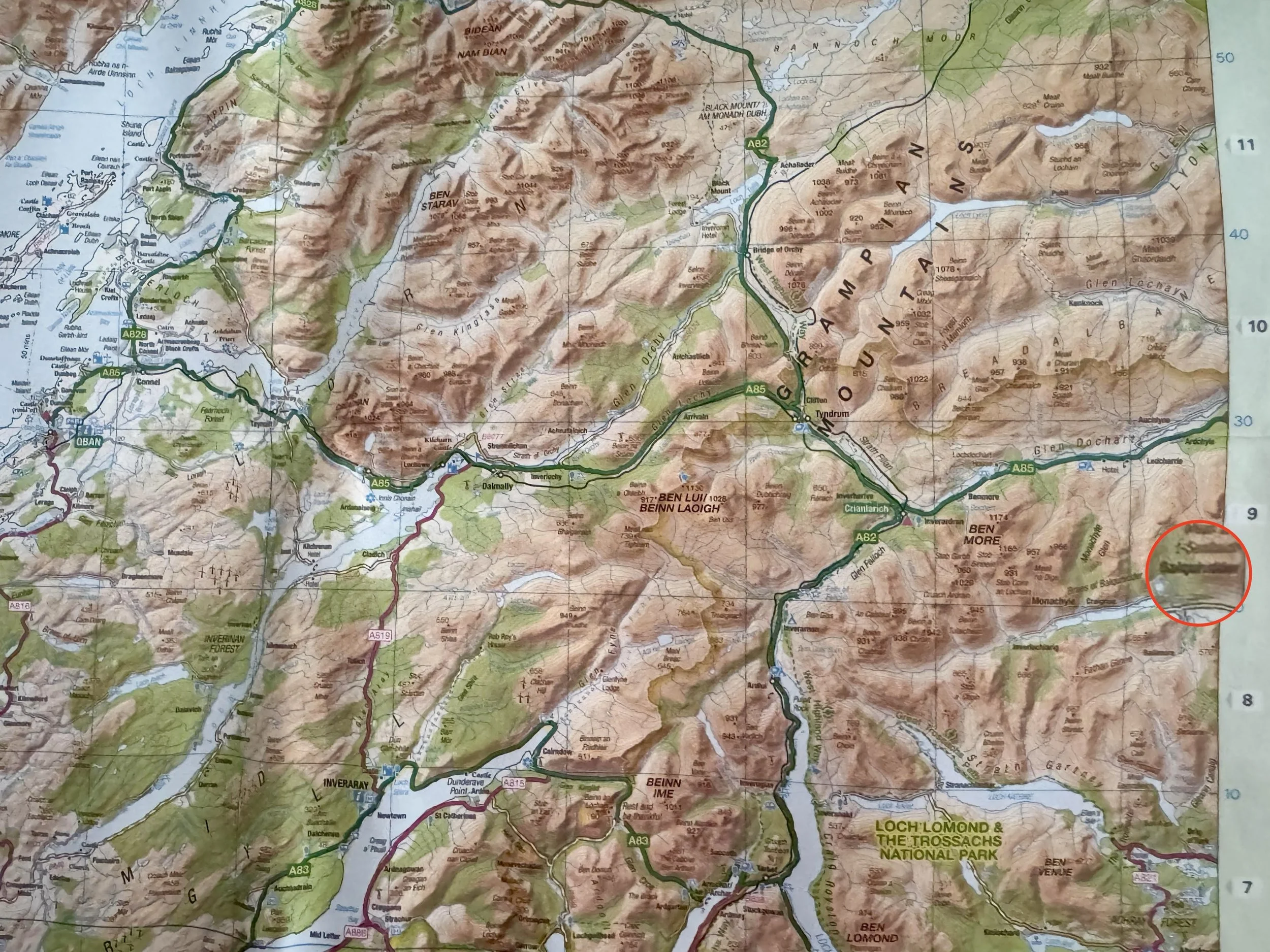
Balquhidder is located near a geological frontier between Highlands and Lowlands. The east–west facing glen just makes it onto a Road Map of Western Scotland & The Western Isles (see the area circled in red for Balquhidder’s location). OS Road 1: 250 000 scale.
Balquhidder lies close to a geological frontier between Highland and Lowland Scotland. It became crown land from 1436 and, during the 1400s and 1500s, we find Scottish kings granting land in the parish to various lords and royal favourites. In time, much of the glen became part of the extensive estates of powerful Perthshire families such as the Murrays of Atholl and, to a lesser extent, the Drummonds of Perth. However, in 1475, King James III appointed Colin Campbell, 1st Earl of Argyll, his Lieutenant, and Argyll’s jurisdiction extended as far east as Balquhidder. This period also saw the rise of the Campbells of Glenorchy, a powerful branch of Clan Campbell, who were to become major players in the region, controlling cattle droving routes and re-fortifying or building castles from Kilchurn on Loch Awe to Edinample, five miles north-east of Balquhidder.
Clan Campbell picked the right side (Robert the Bruce) in the 14th-century Wars of Independence and had expanded rapidly from its Loch Awe base at the expense of neighbouring families in Lorn such as the MacDougals, the Stewarts and McLaurins of Appin, the MacIntyres of Glen Noe, on the south bank of Loch Etive, and the MacGregors, more inland at Glenstrae and Glen Orchy. If one looks at heads of families listed in Balquhidder rentals or hearth taxes in the late 1600s, we see names such as McLaren, McIntyre, McGregor and Fergusson. Some historians (see here) have suggested that a number of these names, which are also common in the old district of Lorn in the west, might be there as a result of Campbell expansion east, and that this may have disrupted Atholl relationships with tenants in Balquhidder.
In the 1700s, there was a dispute over feus (a Scots form of feudal land tenure) at the western end of the glen. According to Atholl estate papers, Rob Roy MacGregor supported MacIntyre tenants in Easter Inverlochlaraig who were threatened with the removal of their goods, and who were described as ‘a tribe’ who had lived there ‘time unknown’ (Stevenson 2004,182 ).There were certainly friendship and kinship links between Balquhidder MacLarens and Stewarts to the east, and Appin Stewarts on the west coast. When Rob Roy fought a duel in 1734 over disputed leases in the west of the glen and at Kirkton (beside the Old Kirk), the MacLarens were not only supported by local Stewarts, but the Stewarts of Appin and of Invernahyle. MacGregor’s opponent in the duel was a champion probably provided by one of those latter families (Stevenson, 218). Are we looking at old West Highland loyalties and rivalries playing out in the glen as late as the 17th and 18th centuries?
A decade after Rob Roy’s death, Donald MacLaren of Invernenty fought at the Battle of Culloden and was in extremis in the aftermath of the disastrous Jacobite defeat of 1746. Shortly after, the title of Easter Invernenty was signed over to Dugald Stewart, 9th Chief of Appin, who was a secured creditor, and Appin placed his own tenants there (Lord Stewart, 2024). Donald was later described as having been a follower of the Chief of the Appin Stewarts. Much ink has been spilled on whether Donald MacLaren fought in the Atholl Brigade or with the Appin Stewarts (perhaps a rather neat reflection of Balquhidder’s position on an east-west frontier). Some historians suggest he may have been of use to Charles Stewart of Ardshiel, Colonel of the Appin Regiment, because he was a cattle drover and knew the routes down into England - a stirring account of MacLaren’s adventures post-Culloden can be found here. An alternative examination of the evidence associating him with the Atholl Brigade can be found here.
Close connections between Balquhidder and the west coast, therefore, seem to have survived well into the 18th century. While it was once located on the edge of the medieval Earldom of Strathearn to the east, and in modern times incorporated into the county of Perth and later, as part of Stirlingshire, it is also a glen which, quite literally, looks west. Indeed, Balquhidder is a mere 40 miles as the crow flies from Appin.
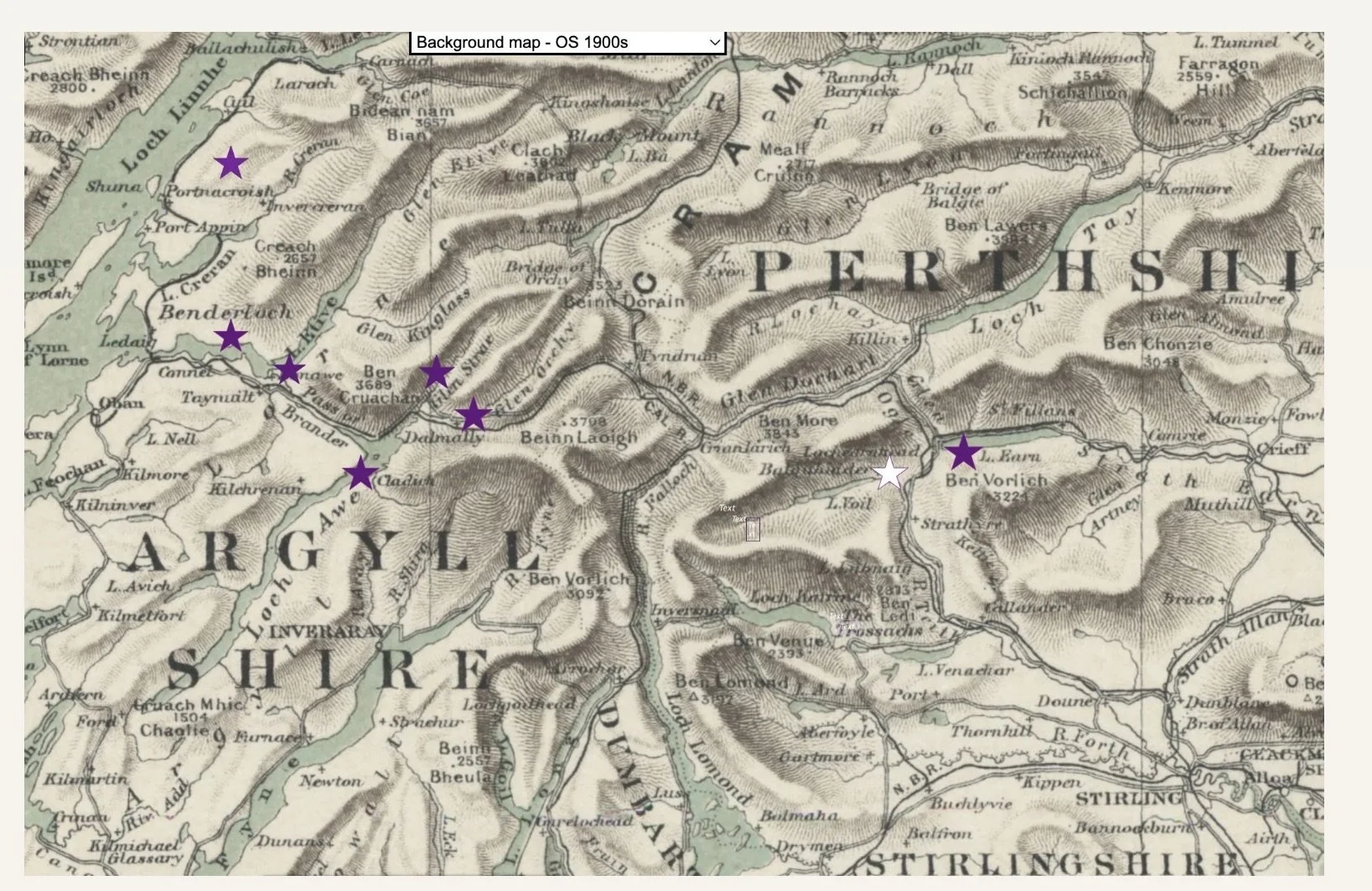
Stars mark sites mentioned in the text above. Balquhidder (in white) is 40 miles as the crow flies from Appin on the west coast, and lies near the junction of important cattle droving routes. Credit: Historic Environment Scotland PastMap OS 1900s.
If there is a galley depicted on Balquhidder’s Angus Stone (see Blogs 1 & 2), is it a visual reference to a wave of migration and influence from the west in the 1400s–1500s, and a changing landscape of land holding? And is its simplistic form a reflection of Balquhidder’s location on the periphery of the late medieval elite culture from which such symbols originally sprang? It is worth noting that in 1470, Colin Campbell, 1st Earl of Argyll, acquired the Lordship of Lorn through marriage to a Stewart heiress (Glen Orchy marking the eastern boundary between Lorn and Breadalbane). The Galley of Lorn from this date appears on the coat of arms of both the Earl of Argyll and Campbell of Glenorchy. Indeed, as late as 1635, Campbell of Glenorchy was commissioning the building of a birlinn, probably to put into the service of the Marquess of Argyll’s campaigns in Ireland (see McWhannel here for a fascinating discussion on Argyll boat-building). While the Argyll birlinn was built in Lorn, Glenorchy had access to revenues from both his Argyll and Perthshire estates, as well as areas of woodland.
Do get in touch below if you wish to contribute to the debate.
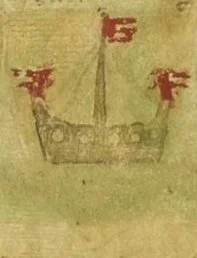

1. MacDougall Lords of Argyll-Lorn. Balliol Roll, 14th century.
2. Stewart Lords of Lorn, derived from the MacDougal Lordship of Lorn. 18th century facsimile of Sir David Lyndsay’s Armorial (16th century).
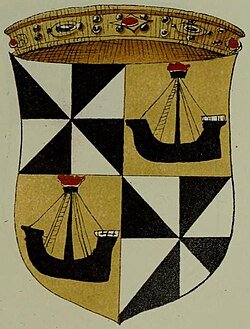
3. A lymphad (galley) was incorporated into the coat of arms of the Earls of Argyll after the acquisition of the Lordship of Lorn in 1470, and was also adopted at this time by the Campbells of Glenorchy, later Earls of Breadalbane. 18th century facsimile of Sir David Lyndsay’s Armorial (16th century).
References
Rixson, D 1998 The West Highland Galley. Edinburgh, Birlinn
Steer, K A and Bannerman, J W M (eds) 1977 Late Medieval Monumental Sculpture in the West Highlands. Edinburgh, RCAHMS pages 205-206.
Stevenson, D 2004 The Hunt for Rob Roy: the man and the myths. Edinburgh, Birlinn, pp 182, 218.
Websites:
https://clanmaclaren-history.org/donald-the-drover
https://glendiscovery.com/the_clans_of_balquhidder.html
https://www.walterscottclub.com/2024-Lord-Stewart
stewartsofbalquhidder.com/stewart-families/stewarts-of-glenbuckie/
https://stewartsofbalquhidder.com/stewart-families/stewarts-of-ardvorlich/
Extended references see here