5. A curious windowsill
Ogham?
A marked stone in Balquhidder Old Kirk
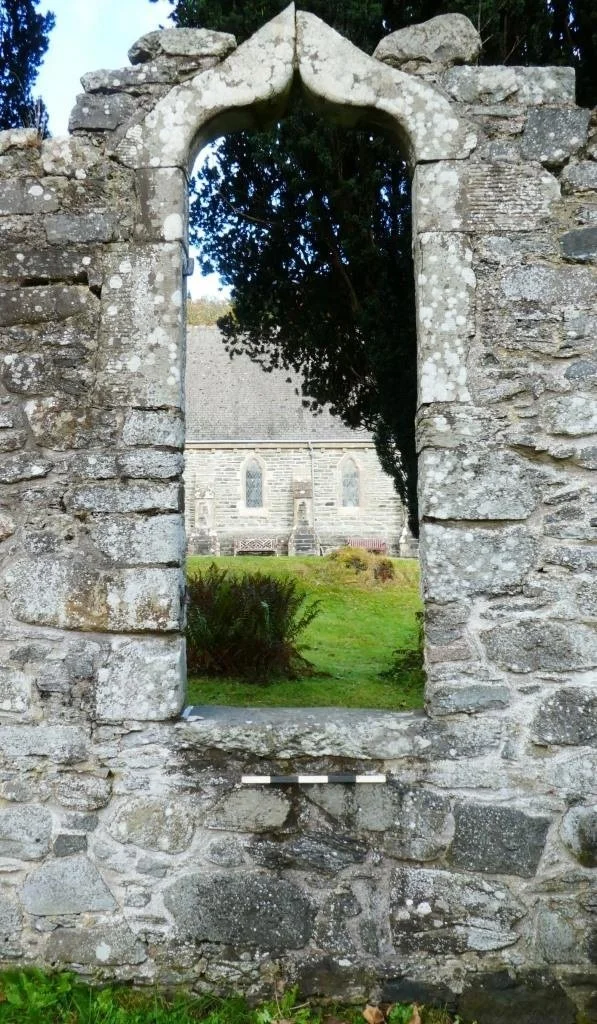
The remains of the Old Kirk at Balquhidder give an air of picturesque antiquity to the surrounding churchyard. But the impression is misleading because it wasn’t only time that took its toll on the old church. In 1853–5, when David Carnegie paid for the construction of a new church (the present Parish Church), he used ‘every means that skill and ingenuity could devise to give the abandoned church the appearance of an old ruin’ – even though it had only been built in 1631. He razed to the ground much of its west and north walls, but preserved the east gable end with its small belfry. He also knocked down the upper levels of the south wall, though taking care to preserve the ogee arches at the tops of two of its windows. The arches had been added in 1774, just 80 years before, but they reflected an increasing interest in, and revival of, medieval architectural styles – the Gothic Revival.
1.
However, one of those windows has a stone sill bearing markings that may point to the much earlier period of worship in Balquhidder – predating even the construction of the medieval Catholic church, which the Protestant Old Kirk had replaced. The first known mention of a church at Balquhidder is in a papal bull of 1237, but when the church was built is not known. There is also a more ancient tradition, relating to a Saint Angus who at some unspecified date is said to have brought Christianity to the Balquhidder glen, his name remembered in local traditions and landmarks.
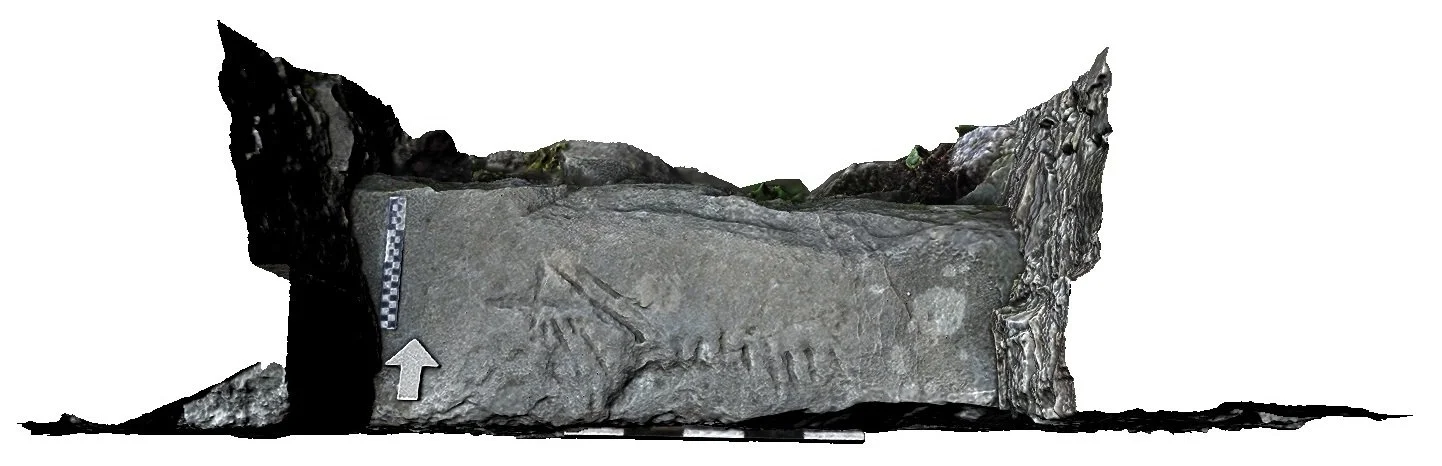
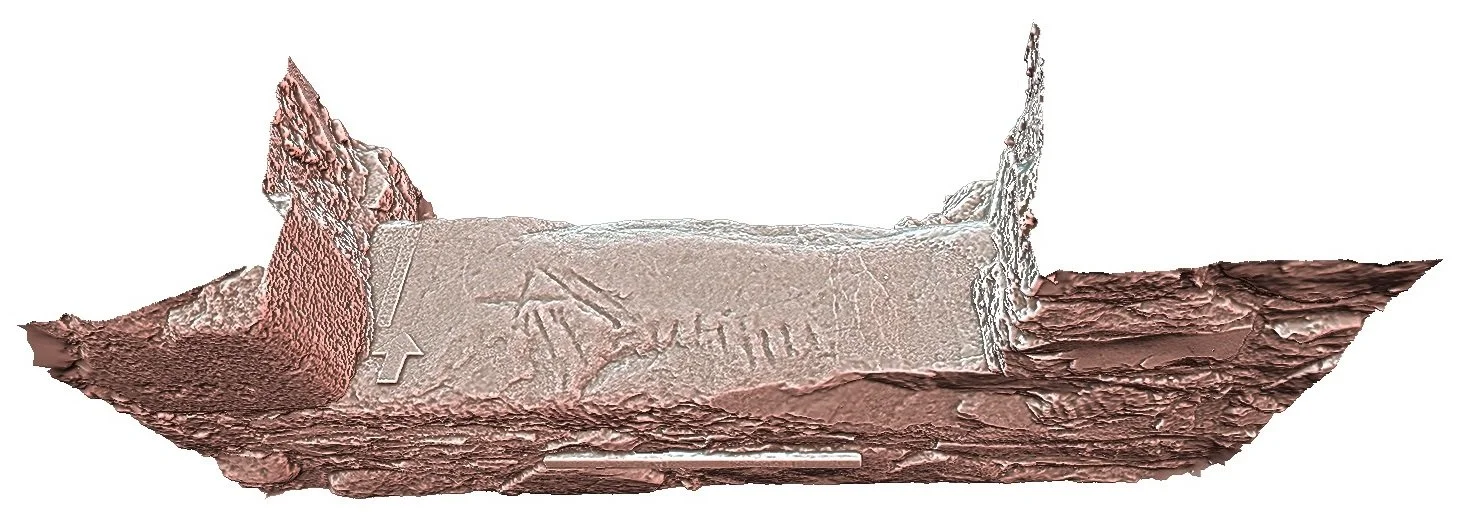
The windowsill’s upper surface bears a small incised cross (with a number of lines running from it) and a set of parallel and evenly spaced linear markings which bear some similarity to ogham (images 2 and 3). Ogham is a form of medieval script, used in Ireland and Britain, that reached its height between c. 400–900 AD – during the early middle ages, possibly the general time of Saint Angus. The marks have been examined by Katherine Forsyth, Professor of Celtic Studies at the University of Glasgow, and the acknowledged authority on ogham in Scotland, and she has confirmed at least the possibility that the parallel markings are ogham (image 4). Their certain identification, however, is hampered by damage to the sill stone potentially before and/or during the building of the Old Kirk. Although the ogee arches are of 18th-century date, and of a visibly different age (image 1), there is nothing to indicate that this windowsill (1.33 m long, 0.42 m wide and 0.13 m thick) was not an integral part of the 1631 construction.
2.
Ogham is commonly found carved on stone pillars, its sets of lines (up to four per ‘letter’) arranged across a ‘stem line’ – the vertical edge between two adjacent faces. The parallel markings on this stone run across its surface towards its outer (southern) edge, the flaked damage to which is clearly visible in processed 3D images (image 3). Parts of eight adjacent lines are visible (from E–W), and then, after an area of damage, at least one further line to the west. However, the dressing of the stone’s outer face to make it flush with the church wall (in contrast to its less regular inside face) would have removed any corresponding marks on the adjacent (now vertical) face, i.e. on the other side of the stem line. Nonetheless, despite the damage, it appears that some care was taken to make these marks easily visible. At either end, where the stone fits into the surrounding masonry, its upper surface has been smoothed and slightly lowered, serving to emphasise the markings in the central area.
3.
The origins of this stone, and its history of use prior to 1631, are unknown, but if the parallel marks are indeed ogham, then the stone could well have predated the construction of the medieval church. It may have remained as a separate object standing in the landscape, or at some point brought to, and perhaps into, the medieval church. The small incised cross is perhaps a later addition, giving the stone a more explicitly Christian association, while the lines running between the cross and the ‘ogham’ could be the latest marks, possibly scored by people coming to the church to swear allegiance to a chieftain, or as an act of reverence to a saint, traditional practices surviving well beyond the Protestant Reformation. Over the centuries, the evident antiquity of these markings may have given the stone a historical and religious significance that transcended doctrinal and denominational differences. And in creating his ruin David Carnegie perhaps inadvertently preserved something much older than he realised.

4. Example of ogham writing
Click this link for the latest research on ogham: AHRC/IRC Project OG(H)AM: Harnessing digital technologies to transform understanding of ogham writing, from the 4th century to the 21st.