4. A priest, a boat and a bell
Angus Stone - galley or vestment (or both)?
In our first two blogs we discussed the possibility that, incorporated within the carving of a priest on the Angus Stone, there is the image of a galley (a small ship or boat), with a curved hull, high stem and stern post, mast and stays. Depictions of galleys are often found on crosses, grave-slabs and other memorials in the West Highlands, but none, as here, superimposed on a human figure.
The figure itself, identifiable as a priest by the chalice he holds, is simply and crudely executed. He has a slightly flattened round head, round eyes, a long nose and a short thin mouth, all atop a long thick neck. His bent, handless arms meet at the chalice he holds in front of his chest in a cruciform arrangement. His clothing, depicted from his narrow waist down, is shown as a skirt-like garment, which flares to a wide hem above his ankles, with a triangular design on its front.
In describing the Angus Stone, as first illustrated in his Sculptured Stones of Scotland (1967, plate 67.2), John Stuart referred to the figure as ‘an ecclesiastic in his vestments’. The illustration, however, is not entirely accurate, the triangular feature on the vestment being shown with a straight, horizontal line at the base – not the curved line of the suggested galley’s hull as clearly revealed by photogrammetry. Ross and Cooper’s illustration (1918–19, plate 3.1) is slightly different, showing a curved line at the base of the triangle; they also mention vestments, referring explicitly to ‘the shape of the chasuble’.
Medieval effigies of ecclesiastics, on memorials and other objects, give us a good idea of the style of vestments worn in the late medieval period. Characteristic components were the alb and the chasuble. The alb is a long robe reaching to near the feet, with a level hem at the base, and this seems to be the long skirt-like robe shown on the Angus Stone. The chasuble is a shorter, sleeveless outer vestment worn over the alb, and on medieval images it has a curved (sometimes slightly pointed) hem at the front.
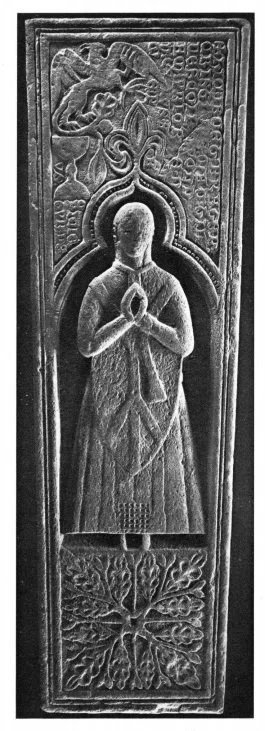
A common feature of the chasuble is the orphrey, a strip of decorative material running down its front, often with branches angled up from chest to shoulders. However, one variant, rarely found outside the West Highlands after the 14th century (Steer and Bannerman 1977, 29–30), also has a lower pair of branches angled downwards to the hem. Examples of this form can be seen on the effigies on the Guthrie bell-shrine (possibly from Argyll or Iona) (ibid plate 39.B), as well as on a number of west coast memorials, such as the Iona stone effigies of Abbot John MacKinnon and Prior Cristinus MacGillescoil (ibid plate 10.C).
It is understandable, therefore, that both Stuart, and Ross and Cooper, should have seen features of liturgical vestments in the depiction of the clothing on the Angus Stone. If the triangular feature was intended to represent the downward branching shape of an orphrey it is notable that only its lower part is shown, possibly because to have extended it upwards would have interfered with the depiction of the chalice, surely the focus of the carving.
It was only the single comment ‘galley?’ by K A Steer, in the National Monuments Record of Scotland (NMRS), which raised the possibility of an alternative interpretation – even if his observation was not followed up – until now.
Is this similarity in shape between galley and orphrey mere coincidence? And if so, which is being depicted? Or was the apparently unsophisticated sculptor of the Angus Stone making a rather subtle point, giving renewed expression to a long-term relationship between the inland glen of Balquhidder and the lochs and isles of the west coast (see Blog 3: A glen that looks west)? There is a huge variation in the craftsmanship displayed by these very different objects, but it seems at least possible that the sculptor of the Angus Stone, familiar with the symbols of west coast iconography, deliberately used a clever device to combine a characteristic feature of West Highland vestments with a depiction of a West Highland galley.
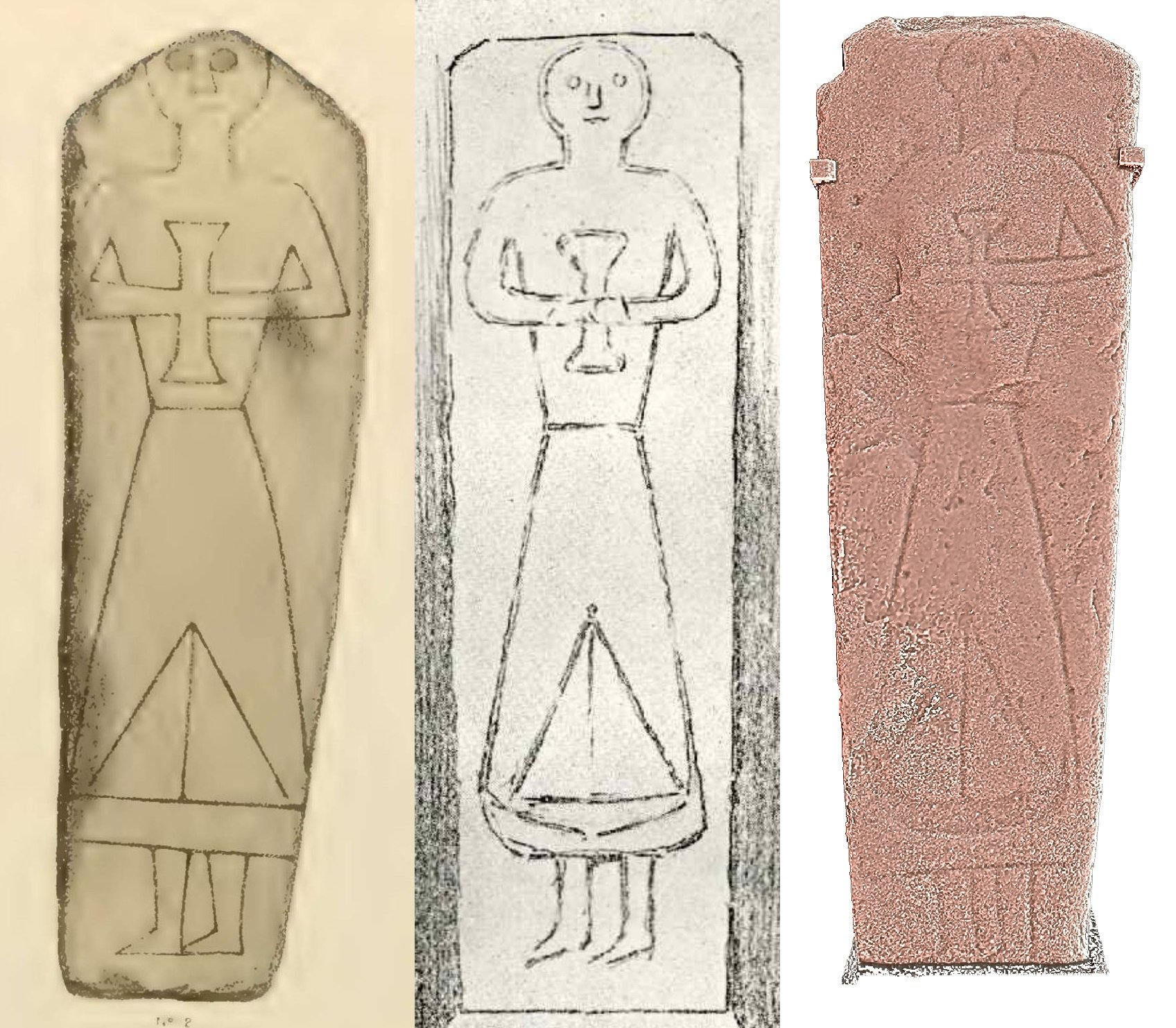
1. The Angus Stone, Balquhidder Parish Church (L-R): Stuart 1867; Ross and Cooper 1918–19; Image still , BGCP 2025
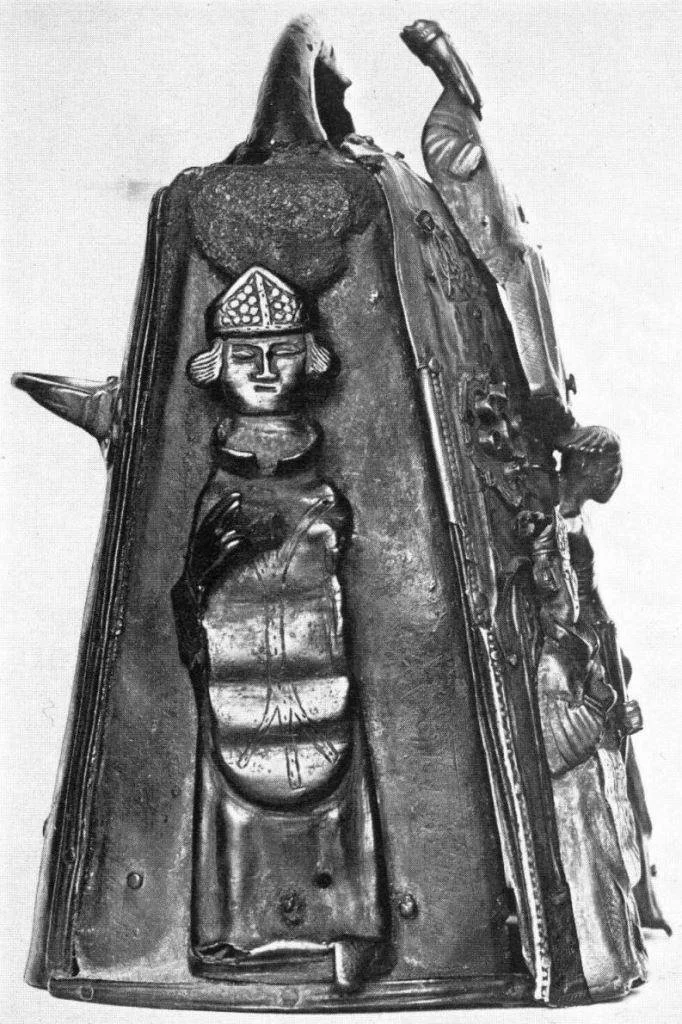
2. Image of an abbot or bishop, showing the detail of his distinctive vestments. Guthrie Bell Shrine, National Museums of Scotland, Steer and Bannerman 1977, plate 39B
3. Effigy of Prior Cristinus MacGillescoil (Iona), in Steer and Bannerman 1977, plate 10C
References
Steer, K A and Bannerman J W M (eds) 1977 Late Medieval Monumental Sculpture in the West Highlands. Edinburgh, RCAHMS
Stuart, J, 1867 Sculptured Stones of Scotland Vol 2. Aberdeen, Spalding Club
Ross, T and Cooper, D D, 1918–19, Saint Angus’ Stone, Balquhidder, and its replacement in the parish church, with ecclesiological notes, Trans Scot Ecclesiol Soc 6 (1), 30–7
For further information on sources see here BGCP Bibliographic References after the last entry .